

How To Fix Concrete Dusting
Information from the National Gear up Mixed Concrete Association
WHAT is Dusting?
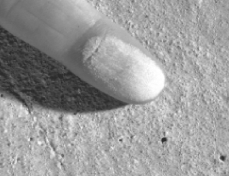
Dusting Concrete Surface
Formation of loose powder resulting from disintegration of surface of hardened concrete is called dusting or chalking. The characteristics of such surfaces are:
- They powder under whatever kind of traffic
- They can exist hands scratched with a nail or even by sweeping
WHY Practice Physical Floors Dust?
A concrete floor dusts nether traffic because the wearing surface is weak. This weakness is acquired by:
- Any finishing operation performed while drain water is on the surface or before the concrete has finished bleeding. Working this drain water back into the top one/4 inch [six mm] of the slab produces a very high water-cement ratio and, therefore, a depression force surface layer.
- Placement over a non-absorptive subgrade or polyethylene vapor retarder. This reduces normal absorption by the subgrade, increases bleeding and, as a result, the risk of surface dusting.
- Floating and/or troweling operations following the condensation of moisture from warm humid air on cold concrete. In cold weather physical sets slowly, in detail, cold physical in basement floors. If the humidity is relatively loftier, water volition condense on the freshly placed concrete, which, if troweled into the surface, will crusade dusting.
- Inadequate ventilation in enclosed spaces. Carbon dioxide from open salamanders, gasoline engines or generators, power buggies or mixer engines may cause a chemical reaction known every bit carbonation, which profoundly reduces the strength and hardness of the concrete surface.
- Insufficient curing. This omission frequently results in a soft surface peel, which volition easily grit under foot traffic.
- Inadequate protection of freshly placed concrete from pelting, snow or drying winds. Allowing the concrete surface to freeze will weaken the surface and issue in dusting.
HOW to Prevent Dusting
- Concrete with the lowest h2o content with an acceptable slump for placing and finishing will consequence in a strong, durable, and wear-resistant surface. In general, utilize concrete with a moderate slump not exceeding 5 inches [125 mm]. Concrete with a college slump may be used provided the mixture is designed to produce the required strength without excessive haemorrhage and/or segregation. Water-reducing admixtures are typically used to increase slump while maintaining a low h2o content in the mixture. This is particularly of import in common cold weather when delayed set results in prolonged bleeding.
- NEVER sprinkle or trowel dry cement into the surface of plastic physical to blot drain water. Remove bleed h2o by dragging a garden hose beyond the surface. Excessive haemorrhage of concrete tin be reduced by using air-entrained concrete, by modifying mix proportions, or by accelerating the setting time.
- Practise Non perform any finishing operations with water present on the surface or while the concrete continues to bleed. Initial screeding must exist promptly followed past bull floating. Delaying bull floating operations tin can cause bleed water to be worked into surface layer. Do non use a jitterbug, as it tends to bring excess mortar to the surface. DO NOT add water.
- Exercise not place concrete directly on polyethylene vapor retarders or non-absorbent subgrades as this tin contribute to issues such as dusting, scaling, and dandy. Place 3 to iv inches [75 to 100 mm] of a trimmable, compactable make full, such as a crusher-run material, over vapor retarders or nonabsorptive subgrade prior to concrete placement. When high evaporation rates exist, lightly dampen absorptive subgrades but prior to concrete placement, ensuring that water does not swimming or collect on the subgrade surface.
- Provide proper curing by using liquid membrane curing compound or by covering the surface with water, wet burlap, or other curing materials as soon as possible after finishing to retain wet in the slab. Information technology is of import to protect concrete from the environment at early ages.
- Placing concrete in common cold conditions requires concrete temperatures exceeding 50°F [10°C] too every bit an accelerating admixture.
HOW to Repair Dusting
- Sandblast, shot nail or employ a loftier-pressure washer to remove the weak surface layer.
- To minimize or eliminate dusting, utilise a commercially bachelor chemical floor hardener, such as sodium silicate (h2o glass) or metal zinc or magnesium fluosilicate, in compliance with manufacturer'south directions on thoroughly dried concrete. If dusting persists, use a blanket, such equally latex formulations, epoxy sealers, or cement paint.
- In severe cases, a serviceable floor tin can be obtained by moisture-grinding the surface to durable substrate concrete. This may exist followed by properly bonded placement of a topping course. If this is not practical, installation of a floor covering, such as carpeting or vinyl tile covering, is the least expensive solution to severe dusting. This option will require some prior preparation since adhesives for flooring roofing materials will not bond to floors with a dusting problem and dusting can permeate through carpeting.
Follow These Rules to Prevent Dusting
- Use Moderate slump physical not exceeding 5 inches [125 mm]
- Do not outset finishing operations while physical is bleeding
- Practise not broadcast cement or sprinkle h2o on concrete prior to or during finishing operations
- Ensure that at that place is adequate venting of frazzle gases from gas-fired heaters in enclosed spaces
- Use acceptable curing measures to retain moisture in concrete for the start three to 7 days and protect it from the environment
References
- Guide for Physical Floor and Slab Structure, ACI 302.1R. American Concrete Establish, Farmington Hills, MI.
- Slabs on Grade, Concrete Craftsman Series CCS-one, American Concrete Establish, Farmington Hills, MI
- The Effects of Various Surface Treatments, Using Zinc and Magnesium Flusilicate Crystals on Abrasions Resistance of Physical Surfaces, Concrete Laboratory Report No. C-819, U.S. Bureau of Reclamation
- Residential Concrete, National Association of Home Builders, Washington, DC.
- Trouble Shooting Guide for Physical Dusting, Concrete Construction, April 1996.
Back to Concrete Tips
USED WITH PERMISSION FROM THE NRMCA

How To Fix Concrete Dusting,
Source: https://www.nevadareadymix.com/concrete-tips/dusting-concrete-surfaces/
Posted by: harrisfooke1944.blogspot.com
0 Response to "How To Fix Concrete Dusting"
Post a Comment